

The Slop Apocalypse is Only Half the Story
Four dark design patterns are converging. We aren’t ready.

The button on my coffee maker is cracked and disintegrating. It’s a flaw that tells a story. It’s not a short story, but if you are patient with me, I’m going to explain the connection between that button and the impending slop apocalypse.
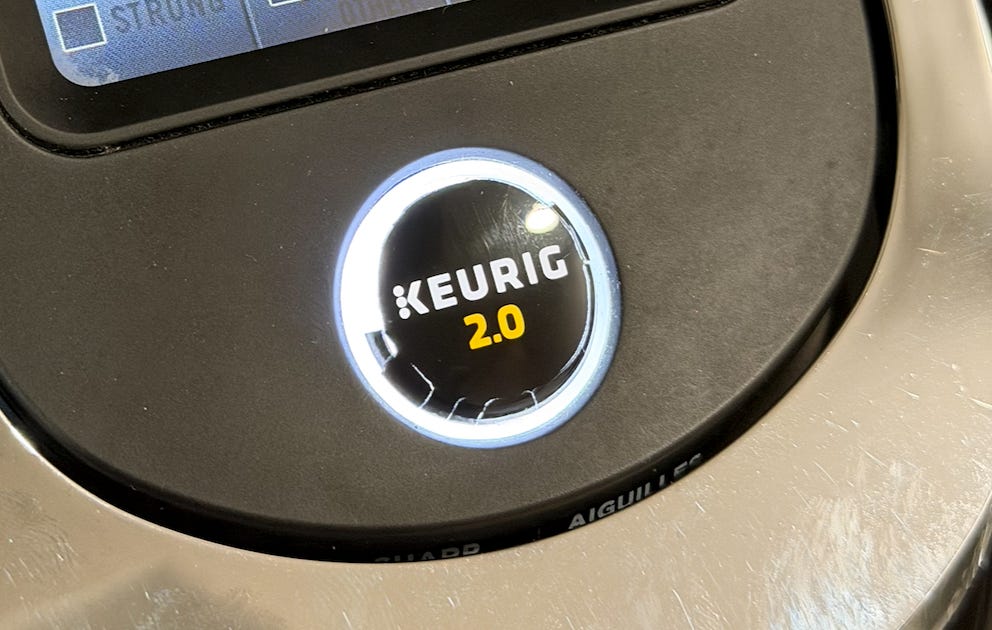
The whole point of the Keurig coffee machine is to reduce coffee making to a single button. One button. And it’s made with thin flaky plastic. It’s the kind of observation that can drive you mad the more you think about it. It’s the tip of an iceberg that hides deep cracks in the social fabric.
Before I pick on the creators of this awful machine let me point the blade of criticism at myself. Why did I buy this thing? It’s not because I value coffee. It’s because I’m lazy and am willing to sacrifice quality for convenience. And to my shame I make this bad decision multiple times a day, returning again and again, pressing that cheaply made button until it breaks beneath the weight of my weakness. Why am I this way? And if I may lump you into my cohort, why are we this way?
The Keurig machine, like all products (so far) is designed by humans. If you’ve never been involved in product design it would probably shock you to see how much time and attention is paid to the tiniest details of mass-produced products. This button was intentionally made to passively fail. The minds that connected the dots between a one-button coffee maker and lazy caffeine addicts, they know how to move product off the shelf. They understand psychology. They recognize that cosmetic failure at this single point will be enough to convince some of us to replace the fully functional machine. Maybe not today, but eventually. It’s not a manufacturing mistake, it is an intentional dark pattern of design that was put there to subtly persuade you to upgrade.
So what? Well, I believe we are living at a point in history where quality is falling off a cliff. It’s more than broken coffee machine buttons, the signs are everywhere. Tell me you don’t feel it. Whether it’s the food we consume, our interactions with customer service, endless ads, the constant upgrade cycles… everywhere you look the degradation is hard to ignore. And it can get much worse.
Right now the term “slop” is reserved for AI generated junk. But the trend is bigger than AI, and I predict that slop will soon swallow the world. The reason for the upcoming slop-apocalypse is a convergence of four things:
Profit patterns - Humans are designing objects to be addictive and disposable because that’s where the money is.
Design by AI - Non-humans are increasingly helping design objects without an understanding of the real world.
Opaque complexity - Modern objects are magic black boxes, too complex to understand, and impossible to reverse engineer.
Consumer ignorance - We are oblivious to quality and care about the wrong things.
Can we stop this? Each pattern above deserves an essay by itself, but I will end this chapter with an invitation. If these ideas resonated with you it is probably because you’ve experience something recently that is an example of eroding quality in your life. I’m collecting these stories. Hit reply or leave a comment that describes the gunk you are noticing. And if you want to see what I’ve written about this in the past, consider my non-fiction book, User Zero.
Thanks for reading and supporting me. Stay creative.
Your friend,
Ade
I agree with you Ade, quality is declining at the people’s expense. Brings the term “enshittification” to mind. And I nowhere do I see this more than the air travel industry. Every airline claims to be “customer-centric,” but take one look at the way commercial airplanes are designed and it becomes obvious that what they *actually* care about is maximizing profit at the expense of passenger comfort. And don’t get me started on Southwest ending its 2 bags fly free policy. They claim to listen to customers and take feedback seriously, but literally no one wanted that.
As I’m sure you know, empathy is at the heart of human-centered design, but it increasingly seems like both are falling out of vogue. And that scares me to my core.