

Why is slop so offensive?
An answer to the anti-touch technology uprising

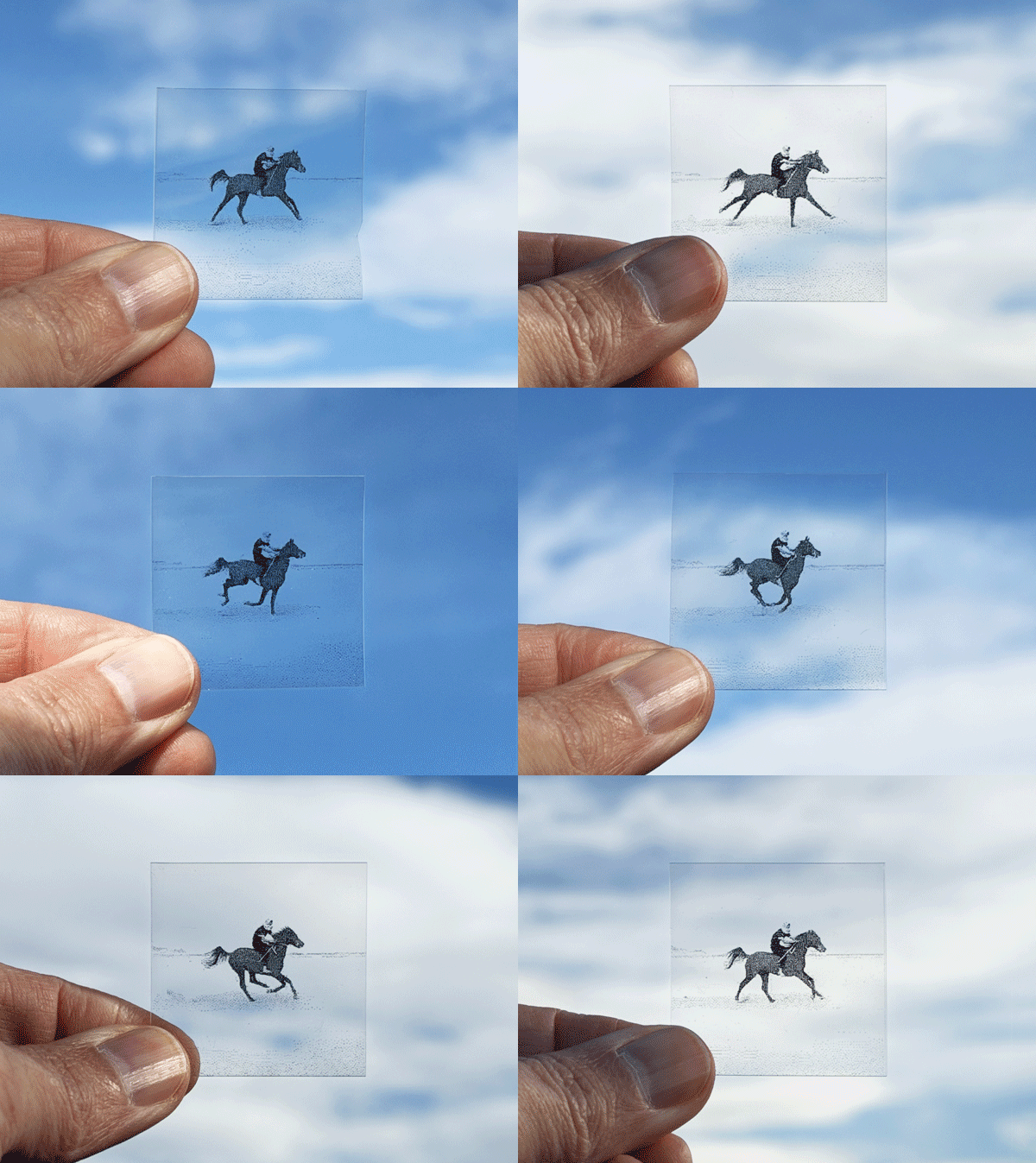
The greatest compliment you can give an athlete is to appreciate their touch. To say a tennis player has great touch is saying that they have control that extends beyond their fingertips and into the racket, they sense every string as it brushes the yellow fibers of the ball. At the highest level of the sport they are not playing a game, they are controlling reality.
Germans have a better word for it called “Fingerspitzengefühl.” It means “finger tip feeling” but it is used to describe people who have a highly sensitive capability to operate in complex situations with delicate tact and intuition. It’s not just for athletes, it’s a skill possessed by leaders in every demanding field.
Touch is what leaves us in awe of professionals operating at the top of their game. We have to replay video in slow motion, pause it, and study them because they’re achievements seem super human. But for the person with touch, these moments happen in real time because they sub-consciously make decisions as naturally as breathing.
It’s not talent, make no mistake. Nobody is born with touch. You only get it the hard way. With putting so much time into your instrument that it becomes a natural extension of your mind.
When you first pick up a pencil, learning to draw seems like it should be simple. You drag it across the paper and erase anything that doesn’t look right. And then you try it and you are immediately humbled. But stick with it and you will eventually develop better touch. Deceptively basic tools will transform into a microverse where you perceive the fibers of the paper and control millions of levels of pressure as you generate infinite shades of gray.
And there is no end to it. You keep pouring passion and time into your craft and your touch improves. Invisible to outsiders, but your heightened abilities allow you to see your progress because as you level up time moves slower, and you will be able to see what no one else notices.
Do all tools allow you to develop touch? No. But it might surprise you that a keyboard does, after all, a keyboard is physically disconnected from the text that appears on screen. But like a joystick in the hands of a virtuoso video game player, it is possible to extend ourselves into a computer and control the machine with astonishing dexterity. A developer writing code is not tapping on keys, they are aligning complex systems to match their models that exist only in their mind.
So if we can extend ourselves into a computer, the next question is, inevitably, AI. Can you develop touch with a generative large language model? Some people are going to say yes. I disagree.
You can definitely lose yourself in a flow state working with a chatbot. And I’m not saying you can’t make amazing, world-improving things with it. My claim is that it is impossible to develop touch with it. In this regard, it is one of the few tools, perhaps the first tool ever, that resists, discourages, and is designed to be anti-touch.
No, a large language model is not an instrument. AI is an anti-instrument. Let’s understand why…
Hopefully you don’t need me to tell you that there is no intelligence behind an LLM. But there is probability. They are amazing prediction machines. Outsourcing prediction to a machine prevents you from developing touch. To understand why, let’s dissect what happens when you ask an AI to make something.
Let’s say we have an idea for something to make. We decide we want a picture of a Ford Mustang. We see the car in our head and we write prompts that refine the computer’s output until the image on screen matches our mental picture. This sounds a lot like touch, we are connecting our minds to a machine, right? What’s the difference?
The difference is that you are not making something, you are describing something. Describing a backhand, no matter how accurately, does not make me a tennis player. Asking for a photo does not make me a photographer. Requesting a song doesn’t make me a musician. Describing features does not make me an engineer. But it sure is fun to pretend, and that’s why the pitch for AI is so seductive. It lets you pretend to be a pro without having to do the difficult work of developing a feeling for the work.
Again, don’t hear me saying that the output of an LLM is automatically slop. In 99.9% of cases it will be, but in that 0.1% of times where genuine quality comes out, do you know what is different? The person writing the prompt probably has probably put in the time to develop touch in the real world.
I think this is why some people have such a revulsion to slop. Does it feel like an over reaction? So there is low quality junk everywhere, so what? Hasn’t that always been the case? Maybe the unwarranted rage is because we sense, even if we can’t explain it, that LLMs are anti-touch, that they discourage people from mastering a craft. A machine that robs humanity of our capability of transcending our machines offends us deeply.
When I wrote about the slop apocalypse I described the dark patterns that have aligned to erode the quality of our world. But I didn’t give an antidote. Here it is… Master your craft. Put the time into your instrument until it becomes a natural extension of yourself. Develop touch.
Thanks for following me to the bottom of this page. I have this fear that this essay will sound pretentious, as if I claim to have the skills I am describing. I don’t. But I work to get better. If you want to encourage my growth as an artist and writer, consider subscribing to this Substack. And thanks in advance for your likes and comments (even from the people I will offend with my anti-AI take), they help me hone my craft and level up.
Stay creative. Your friend,
Ade
I think the revulsion to slop is not sufficiently interrogated. There’s been a great rushing in by many people who have never been anything other than perfectly alienated from the spiritual nature of craft. They do not comprehend the sin of anti-touchness that is AI because they have not encountered much touch—to stay with your meaning—at all for themselves.
The pain at experiencing the distance between creative expectation and crafted reality is an immensely pleasurable one if embodied for long enough. This is what made us human for so long, this is what gave us meaning. Those of us who know, are appalled. Those of who don’t will never.
Thank you for your illuminating analogies.
I think that a lot of the tech bro relish and drive to duplicate human art by tech is essentially a version of artistic envy in the same vein as moral envy with jobs as explained by David Graeber in his book Bullshit Jobs.
Essentially, tech bros push so hard for AI duplication of the human creative spirit in an attempt to deny the value of the human creative spirit, which they cannot access to the same extent as people who have dedicated themselves to creative crafts outside tech.
I'd add a caveat too, there's probably some of these tech guys who were pushed by parents or other mentors to refuse to indulge art and follow tech as a way to provide for their families and themselves, so there also is probably at least a bit of a class perspective on it too, akin to how Graeber explains that support for the military has some class explanation because anyone can join the military and help people recover from a hurricane or bring vaccines to developing countries etc while joining the doing the same by joining the Peace Corps requires a college degree.
I just posted a similar comment after reading this other post by Connor Wroe Southard that I think you'd enjoy. https://connorwroesouthard.substack.com/p/elon-musk-and-the-war-on-writers/comments